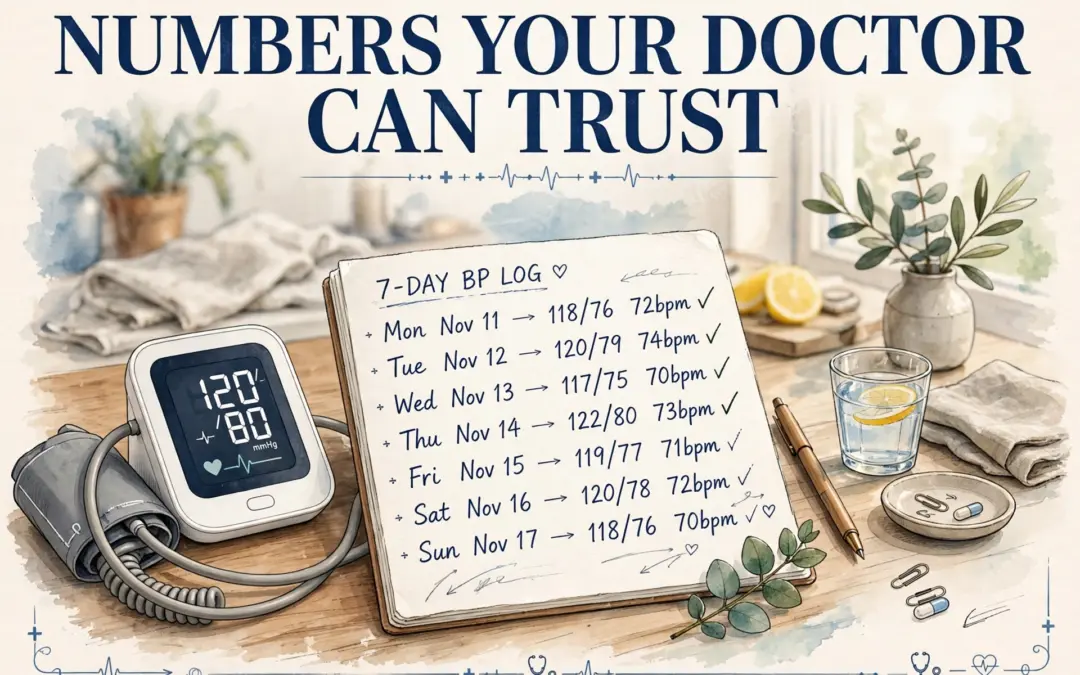
A home blood pressure monitor is one of the most useful health tools you can own — and one of the easiest to use wrong. A cuff that is too small, an arm dangling at your side, or a reading taken right after climbing the stairs can push a number 10 or 20 points away from the truth. That matters, because your doctor may make real decisions from the log you hand over. This article walks through how to measure correctly at home: cuff fit, position, timing, the first-reading effect, and the simple 7-day log that turns scattered numbers into information a clinician can actually use.
Why Home Readings Matter
Office readings have two well-known blind spots. Some people run high only in the clinic — the “white coat” effect — while others run normal in the office and high at home. A week of careful home readings gives your doctor a picture of your everyday numbers, not just your appointment-day numbers. The American Heart Association recommends home monitoring for people with high blood pressure precisely because those everyday numbers help confirm a diagnosis and show whether a treatment plan is working between visits.
The catch: that only works if the technique is sound. Here is the technique.
Start With the Right Cuff
- Size is not a detail. A cuff that is too small for your arm reads falsely high; one that is too large can read falsely low. Measure around the middle of your upper arm and match it to the cuff’s stated range before you buy — and re-check if your arm size changes.
- Upper arm beats wrist. Wrist and finger monitors are convenient but more sensitive to position. A validated upper-arm cuff monitor is the standard recommendation.
- Cuff goes on bare skin. Roll the sleeve up rather than bunching it, and place the cuff so its bottom edge sits just above the bend of the elbow, snug but not tight — you should be able to slip two fingertips underneath.
Position: The Five-Minute Setup
Most bad readings are posture readings. Before you press start:
- Sit in a chair with your back supported and both feet flat on the floor, legs uncrossed.
- Rest your arm on a table so the cuff is supported at heart level. An unsupported arm, or one hanging down, inflates the number.
- Rest quietly for five minutes first. No talking during the reading — even conversation moves it.
- Empty your bladder beforehand; a full one nudges readings up.
Timing: Same Times, Calm Conditions
Consistency beats volume. Measure at the same times each day — commonly once in the morning and once in the evening — so readings are comparable across days. Avoid caffeine, exercise, and smoking for at least 30 minutes before a reading, since all three temporarily raise blood pressure. The Centers for Disease Control and Prevention offers a plain-language overview of measuring and tracking blood pressure if you want a second walkthrough of the basics.
Why the First Reading Runs High
Almost everyone’s first reading of a session is the highest. The small stress of starting — the cuff inflating, the anticipation — produces a mild alerting response. That is why the standard practice is:
- Take two or three readings, about a minute apart, in the same sitting.
- Note them all in your log, or follow your clinician’s preference — many ask you to record the later readings, or an average of the last two, since those are closer to your resting number.
- Do not panic over a single high reading, and do not keep re-measuring until you get a number you like. Both habits corrupt the log.
One reading is a weather report. A week of readings taken the same way is a climate — and climate is what your doctor can actually treat.
Five Mistakes That Quietly Skew Your Numbers
Even careful people get caught by these. Run through the list before your next session:
- Measuring over a sleeve. Fabric bunched under the cuff changes the pressure transfer. Bare arm, every time.
- Talking, texting, or watching tense news during the reading. All of it nudges the number up. The reading takes a minute — give it a quiet one.
- Feet dangling or legs crossed. Sit in a chair that lets both feet rest flat, and uncross your legs; both habits can add several points.
- Measuring right after coffee, a workout, or a stressful phone call. Wait at least 30 minutes after caffeine or exercise, and a few minutes after anything that got your heart going.
- Editing the log. Writing down only the readings you like — or quietly rounding a 148 to “about 140” — feels harmless and destroys the log’s value. Your doctor would rather see honest numbers with a note (“bad night’s sleep”) than flattering fiction.
None of these mistakes is dramatic on its own. Stacked together, they are easily the difference between a log your doctor trusts and one that sends everyone chasing a problem that is really just technique.
The 7-Day Log
A week is the standard window clinicians ask for: twice-daily sessions for seven days gives a pattern sturdy enough to average and discuss. Keep it simple — a notebook page or a printed sheet with:
- Date and time of each session
- Each reading (systolic/diastolic) and your pulse
- A notes column: poor sleep, a stressful day, a missed walk, an unusually salty meal — context that explains outliers
Bring the monitor itself to your appointment at least once, too. Your clinician’s office can compare it against their equipment so everyone knows your device reads true.
What to Bring to the Appointment
- Your 7-day log, with the notes column filled in
- Your monitor and cuff, for a side-by-side check
- A current list of everything you take — prescriptions, over-the-counter products, and supplements — since several common products can affect blood pressure
- Your questions, written down: what range your doctor wants you in, when to call the office about a reading, and when the next check should be
Go Deeper: The Heart Health Playbook
If you want the full picture in one place — how to read your numbers, the lifestyle levers that move them, and how to have a more productive conversation with your doctor — our guide Blood Pressure After 50: The Heart Health Playbook covers it for $19. This weekend it is at its lowest price: code BLKFRIDAY7 takes 40% off through Monday Nov 30, 2026, 11:59 PM ET, bringing it to $11.40.
This article is educational and is not medical advice. Home readings support — they do not replace — your clinician’s judgment. Never change or stop a prescribed medication based on home readings alone; if your numbers concern you, or a reading is very high and you feel unwell, contact your doctor or seek care promptly.