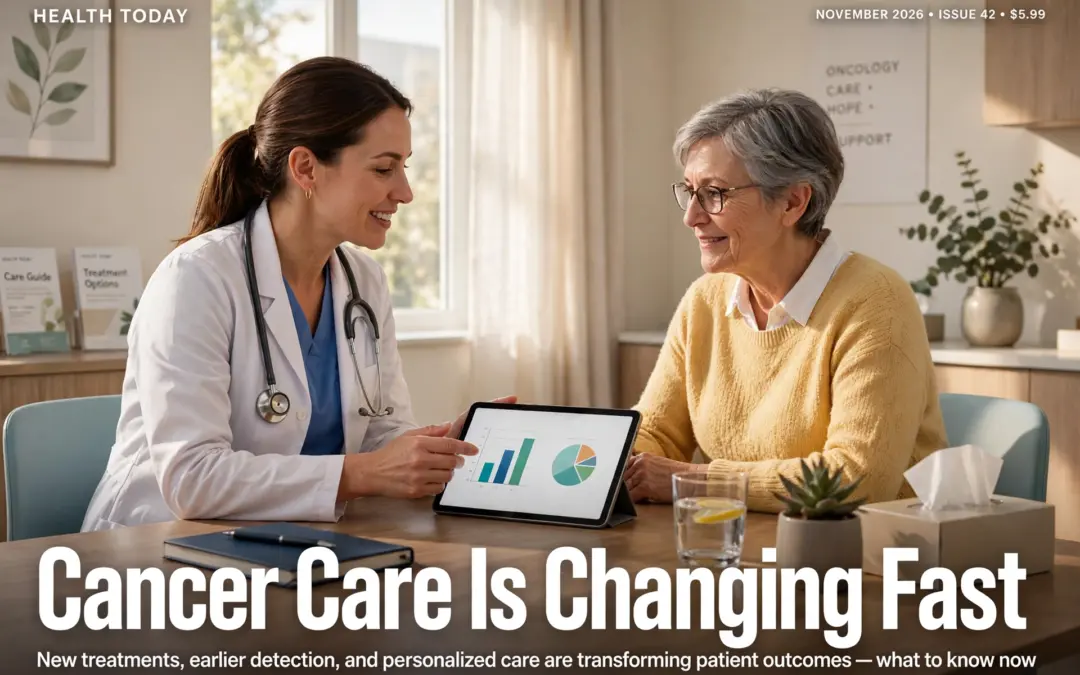
Cancer Care Is Changing Fast: Earlier Detection, Smarter Treatment, and What It Means for You
This article is education only and is not medical advice. Cancer care is individual — decisions about screening and treatment belong in a conversation with your own doctors.
If your picture of cancer care comes from a decade or two ago — one kind of chemotherapy for everyone, detection only after symptoms, treatment that felt like a blunt instrument — it is worth updating. Cancer medicine is in the middle of its fastest period of change in living memory. Cancers are being found earlier, treatments are being matched to the biology of each tumor instead of just its location, and many people are living longer with better quality of life than the old picture suggests.
This guide walks through the three changes that matter most if you or someone you love is facing cancer — or simply trying to stay ahead of it.
Change 1: Finding Cancer Earlier — Including With a Blood Test
Every oncologist will tell you the same thing: the single biggest factor in cancer outcomes is how early it is caught. A cancer found while it is still small and local is, in most cases, a fundamentally different problem from the same cancer found after it has spread.
The established tools still matter most, and they are screening basics worth keeping current:
- Mammograms for breast cancer screening, on the schedule your doctor recommends for your age and risk
- Colonoscopy (or an approved stool-based test) for colorectal cancer screening, generally starting at 45 for average-risk adults
- Low-dose CT scans for lung cancer in people with a significant smoking history, per current guidelines
- Cervical screening (Pap and HPV testing) on schedule
- Prostate screening conversations — PSA testing is a discuss-it-with-your-doctor decision, not an automatic yes or no
The genuinely new development is multi-cancer early detection (MCED) testing: a single blood draw that screens for signals shared by many types of cancer at once — including several, like pancreatic and ovarian cancer, that have no routine screening test today. The best-known example is the Galleri test from GRAIL, which looks for a shared cancer signal in DNA fragments circulating in the blood. These tests are not a replacement for the standard screenings above, a positive result is a starting point for imaging and follow-up rather than a diagnosis, and they are still being studied in large trials. But the direction is clear: detection is moving earlier, and increasingly, it starts with blood.
Change 2: Treatment Matched to the Tumor, Not Just the Organ
The second change is in how treatment is chosen. Increasingly, a tumor is tested — genomically profiled — to find the specific mutations and markers driving it. Two cancers in the same organ can turn out to be different diseases at the molecular level, and they are treated differently. Two ideas explain most of what you will hear about:
Targeted therapy. If a tumor’s growth is driven by a particular mutation or protein, there may be a drug designed to block exactly that driver. These are often pills rather than infusions, and because they aim at the cancer’s machinery rather than all fast-growing cells, their side-effect profile is often different from traditional chemotherapy — though “different” does not mean “none,” and your team will walk you through the specifics.
Immunotherapy. Checkpoint inhibitors and related drugs do not attack the cancer directly. They release brakes on your own immune system so it can recognize and attack the cancer itself. For some cancers — melanoma and certain lung cancers among them — immunotherapy has transformed outcomes that barely moved for decades. Related approaches, including CAR-T cell therapy for certain blood cancers, engineer a patient’s own immune cells into a treatment. Not every cancer responds, and researchers are still learning how to predict which ones will — but the immune system is now a standard weapon in the arsenal, not an experiment at the margins.
Chemotherapy, surgery, and radiation have not disappeared — they remain the backbone of many successful treatments, and they have each gotten more precise. What has changed is that they are increasingly combined with, sequenced with, or in some cases replaced by these smarter options.
Change 3: Care That Treats the Whole Timeline
Modern cancer care also looks different around the treatment itself: genetic counseling when family history suggests inherited risk; fertility and survivorship planning; clinical trials considered early rather than as a last resort; and palliative care — focused on symptoms and quality of life — offered alongside treatment rather than instead of it. Asking about these is not pessimism. It is how good centers practice now.
What Has Not Changed — and Still Matters Most
For all the new science, the highest-value moves in cancer care remain the oldest ones. Standard screenings catch far more cancers today than any new blood test, because they are proven, covered, and available — a multi-cancer blood test is an addition to that list, not a substitute for a colonoscopy or a mammogram you keep postponing. Smoking remains the single largest preventable cause of cancer, and quitting helps at any age. And a new symptom that persists — a lump, unexplained weight loss, a cough that will not leave, bleeding that should not be there — still deserves a prompt appointment rather than a wait-and-see, whatever the newest technology promises. Earlier detection only works for people who show up for it.
It is also worth keeping expectations honest. New treatments arrive unevenly: a breakthrough for one cancer type may mean little for another, access and insurance coverage vary, and headlines about experimental results are describing trials, not guarantees. That is not a reason for cynicism — survival for many cancers has genuinely and substantially improved — but it is a reason to let your own care team, who know your case, translate the news into your options.
Questions Worth Asking Your Oncologist
Whether you are newly diagnosed or accompanying someone who is, these questions open the right conversations:
- Has my tumor been genomically profiled, and did it show any markers with a targeted treatment?
- Am I a candidate for immunotherapy, and how would we know?
- Is there a clinical trial I should consider — now, or at any point in my treatment?
- What is the goal of this treatment — cure, control, or comfort — and what does success look like?
- What side effects should I expect, and which ones mean I should call immediately?
- Should my family members change their screening because of my diagnosis?
Write the answers down, and bring a second set of ears to appointments. Everyone does; no one remembers everything said in that room.
The Bottom Line
Cancer care in 2026 is not the cancer care of a generation ago. Detection is moving earlier — into routine screening done on time and, increasingly, into blood tests that watch for many cancers at once. Treatment is moving from one-size-fits-all toward therapies matched to a tumor’s biology and powered, in many cases, by the patient’s own immune system. The most useful things you can do are unglamorous: keep your screenings current, ask whether new options apply to your situation, and treat a diagnosis as the start of a set of choices rather than a single verdict.
For more on where prevention and longevity science are heading, read Can AI Help Us Live to 120? The Science of AI-Driven Longevity, find plain-language guidance on screening and symptoms at the American Cancer Society, and browse more patient guides on the Health Network hub.